
Transport Museum of Madrid (EMT)
Competition. 3rd Prize
2026
Architects: Ignacio Borrego, Carlos Chacón and José de Villar
Collaborators: Marina Morgan and Álvaro Quintanar
Visualizations: Glassred Studio
Location: Nuevo Mahou-Calderón, Madrid
Area: 8.849 m2
Client: Madrid Municipal Transport Company (EMT)
A MUSEUM WITHOUT WALLS
Is it possible to build a museum open to the city and its citizens? In 1947, André Malraux wondered what a Museum Without Walls would be like. In his text, he developed the idea of how everyday objects for his contemporaries became symbols that accentuated museum spaces, transforming the nature of the exhibited objects, revaluing them for society, but in turn distancing them from the ordinary lives of citizens. Imagine a National Library with free access or a Prado Museum transparent to its urban surroundings.
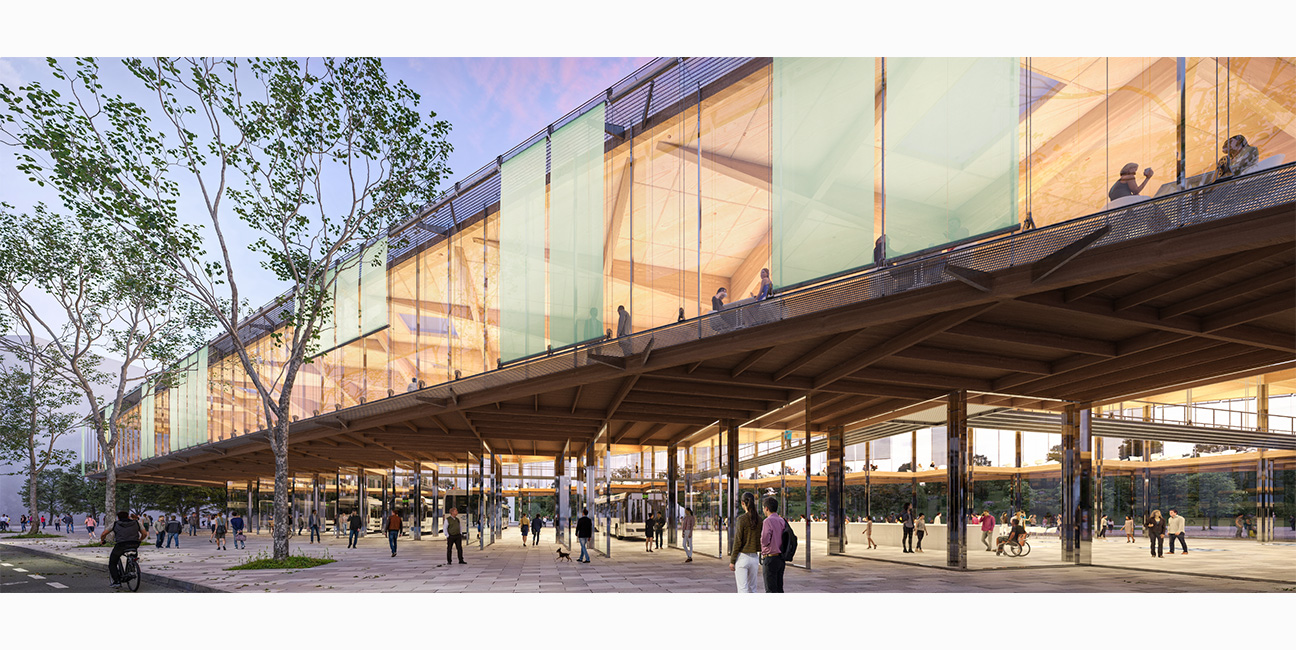
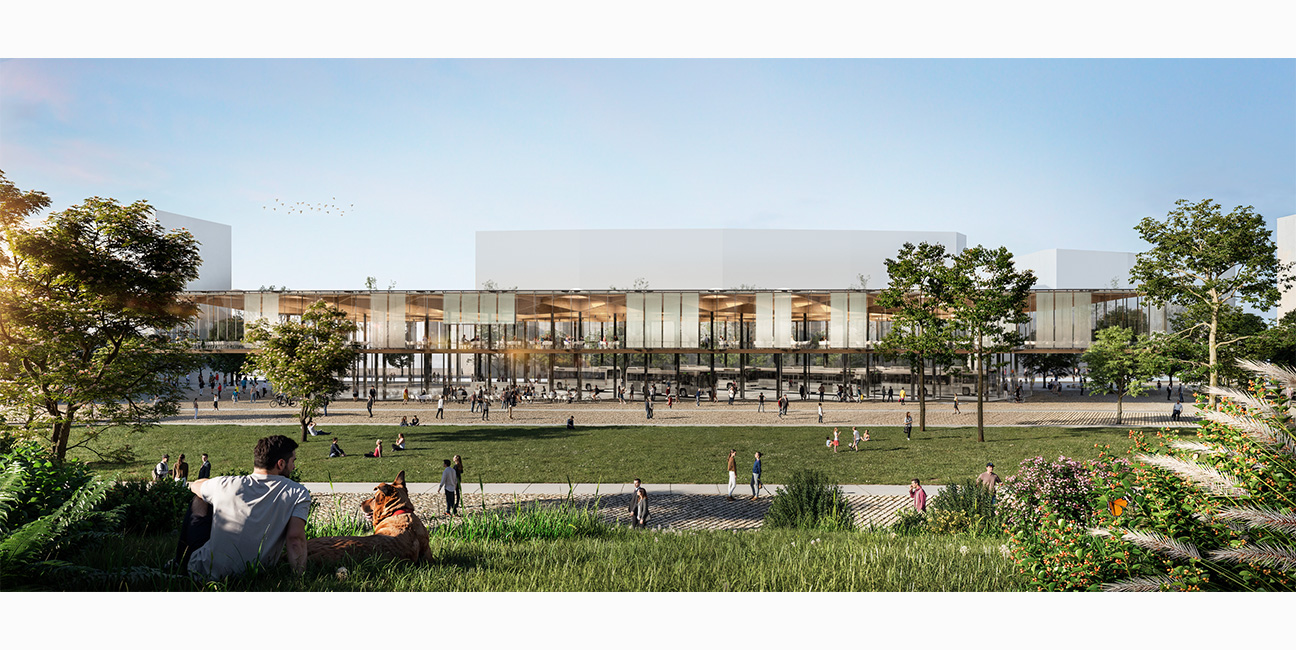
We believe that a museum dedicated to the history of Madrid’s public transport should be open to the public and integrated into the life of the street. A museum that doesn’t house works of art, but rather a heritage that is part of us, of our collective memory. It is a place to preserve and learn about the history that belongs to the life of this city, its streets, and its inhabitants, and at the same time, a space to remember the history of our families and our culture. Our proposal for housing these vehicles, which have been an important part of our daily lives, moves away from the concept of an exclusive museum to be inclusive. Therefore, we believe it should remain connected to the neighborhood in which it is located and, by extension, to the entire city. Its transparent envelope opens at street level, offering this cultural asset protected by a welcoming perimeter overhang.
A THRESHOLD BETWEEN THE CITY AND THE RIVERBANK
We are located in an attractive urban setting next to the Manzanares River. This dual nature, situated between the urban fabric and the Madrid Río linear park, transforms this permeable museum into a transitional space that aims to become part of the riverside green space. In this way, the EMT Museum would serve not only as a cultural center focused on public transportation but also as a shaded area extending the reach of green spaces into the public thoroughfare. The park’s trees will grow larger in the near future, contributing to the museum becoming an extension of their canopies and leaving the lower areas shaded beneath them.
A MUSEUM THAT NEVER CLOSES
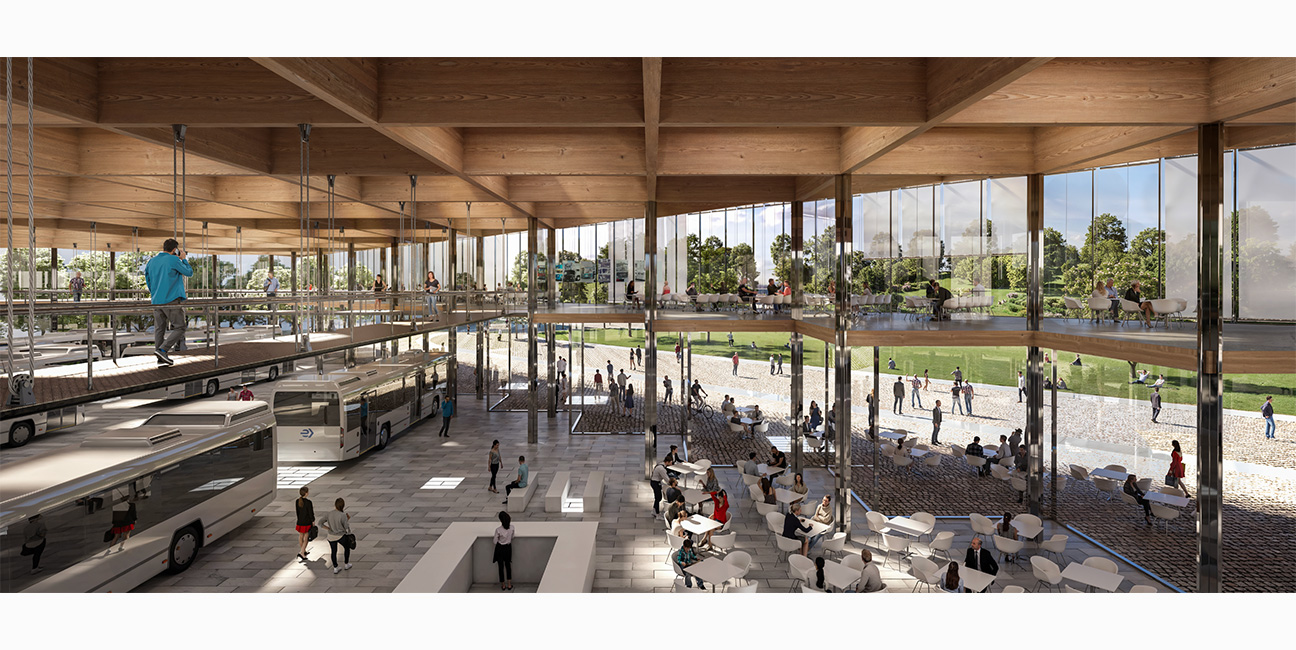
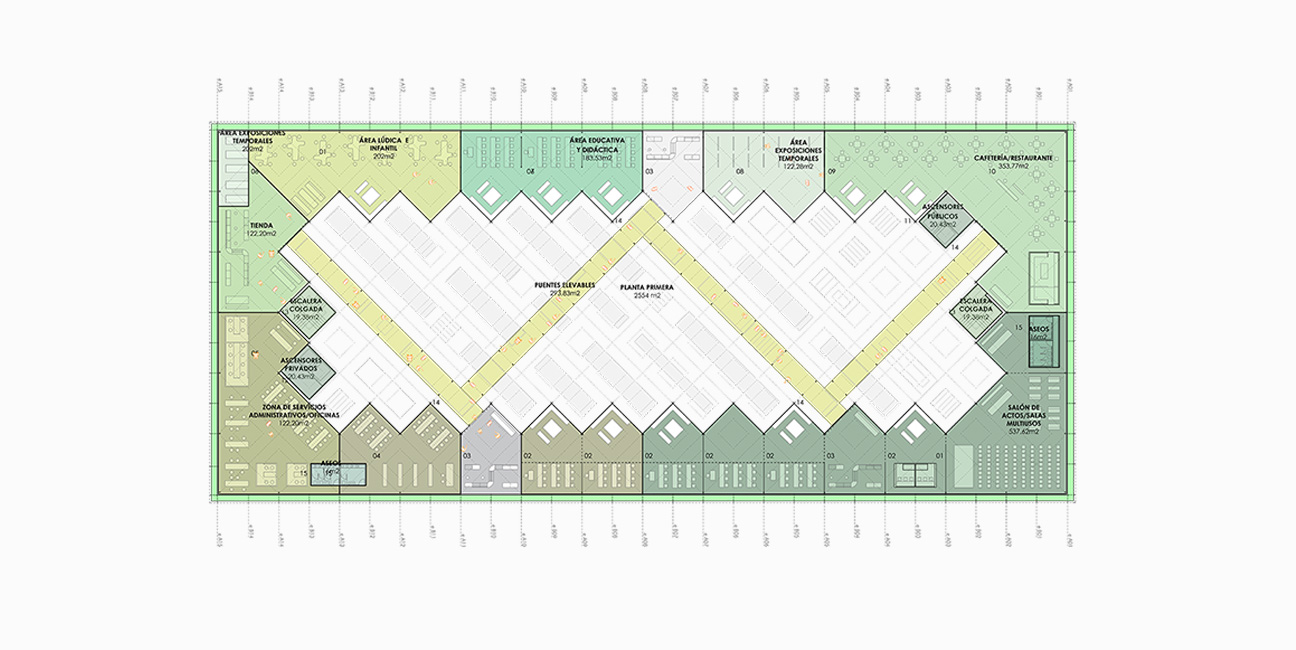
The main hall, which houses the accessible bus collection, is the heart of the museum. The different parts of the museum’s program are organized around it. This hall is located on the ground floor, seamlessly connected to the street and the park, and thanks to its double-height space, it is visible from both the street and the upper floor. Since the museum is open to the public, the visit begins before entering, and the bus exhibition can be enjoyed at any time, any day of the year, as visitors can freely walk around it. Once inside, visitors encounter the access control point and the start of the museum tour, a two-level itinerary that enriches the experience by allowing them to observe the buses up close, from inside the building, and also from above along the walkways that also serve the other areas on the upper floor.
Access to both the building and the main hall is intuitive and direct because the exhibited buses are always visible to visitors. The visit begins at the bus level and continues via a staircase that allows visitors to retrace their steps on a higher level. Access to the additional museum areas is located on the main floor, accessible via stairs and elevators from the lobby. The main floor features more open and continuous spaces on the western side, facing the riverbank, while the more compartmentalized areas are oriented towards the more urban side to the east. The elevated height of this floor establishes a more direct and welcoming connection with Madrid Río, as it is raised approximately 6 meters above the surrounding site. In this way, the main floor program will be situated at river level. The ring of uses on the main floor overlooks both the exterior and the central bus exhibition. Thus, the bus collection is present in every room of the museum. This arrangement allows for the easy and independent opening and closing of different parts of the program without affecting the rest. Below ground level are the spaces that do not necessarily require a direct connection with the surroundings or that may even benefit from their isolation. The bus collection, which is not open to the public, and some specific museum uses that could benefit from being darkened (virtual activities, simulations) are located below ground level.
A VARIABLE ENVELOPE
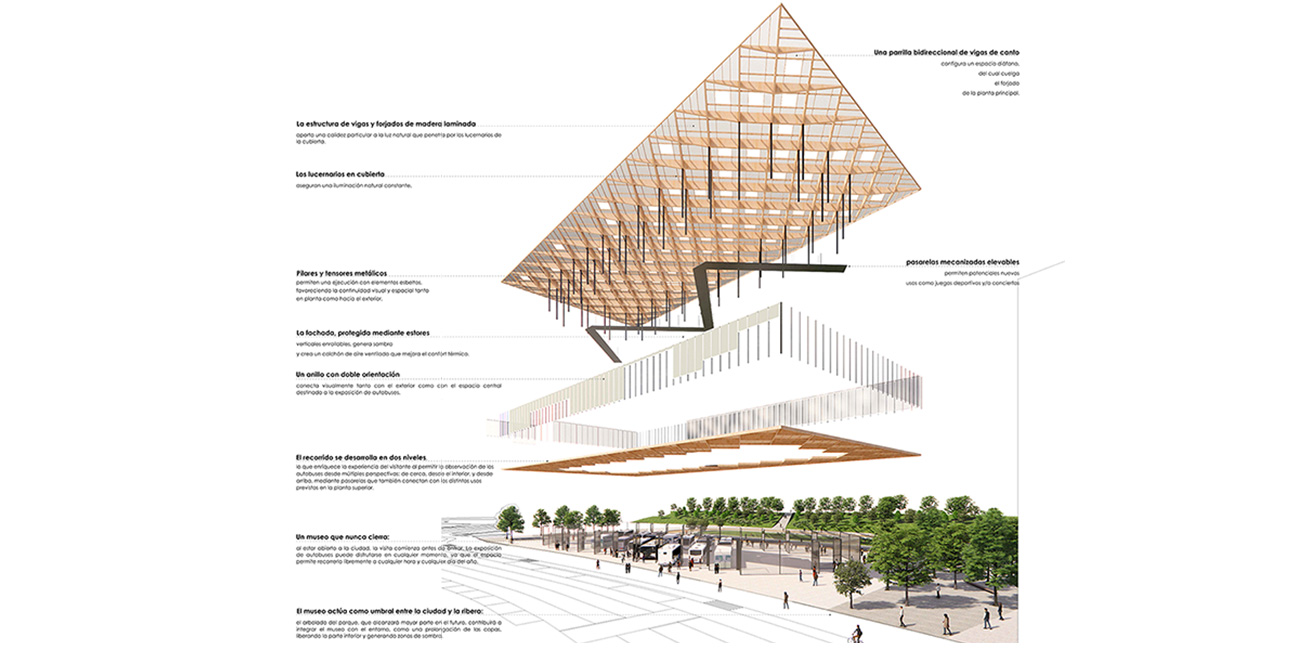
The main bus hall, which includes the entrance area, is a climate-independent, double-height space. Its large dimensions, both in surface area and height, lend themselves to a climate-controlled environment using radiant floor heating, providing comfortable conditions in the lower section while the rest of the volume remains semi-conditioned. This will reduce heating and cooling costs in both winter and summer. The main floor is a ring with dual orientations: facing both the exterior and the central bus exhibition space. In this way, the main bus collection will be visible throughout the museum. The central hall’s lighting is provided and controlled through skylights in the roof, ensuring natural light while minimizing overheating during the summer months. As for the other rooms on the upper level, which are exposed to the exterior on all sides, they are equipped with vertical roller blinds that can be extended to protect the façade with shade, creating a ventilated air cushion. This can occur depending on the time of day, especially at the end of the day in summer on west-facing sides, but also automatically according to cloud cover to ensure maximum natural light, spatial quality, and prevent overheating due to the greenhouse effect. The relationship between the program in the perimeter ring of the main floor, around the central bus exhibition courtyard, allows for cross-ventilation in all rooms during warmer periods, using the skylights as chimneys for warmer air.
A UNIQUE STRUCTURE
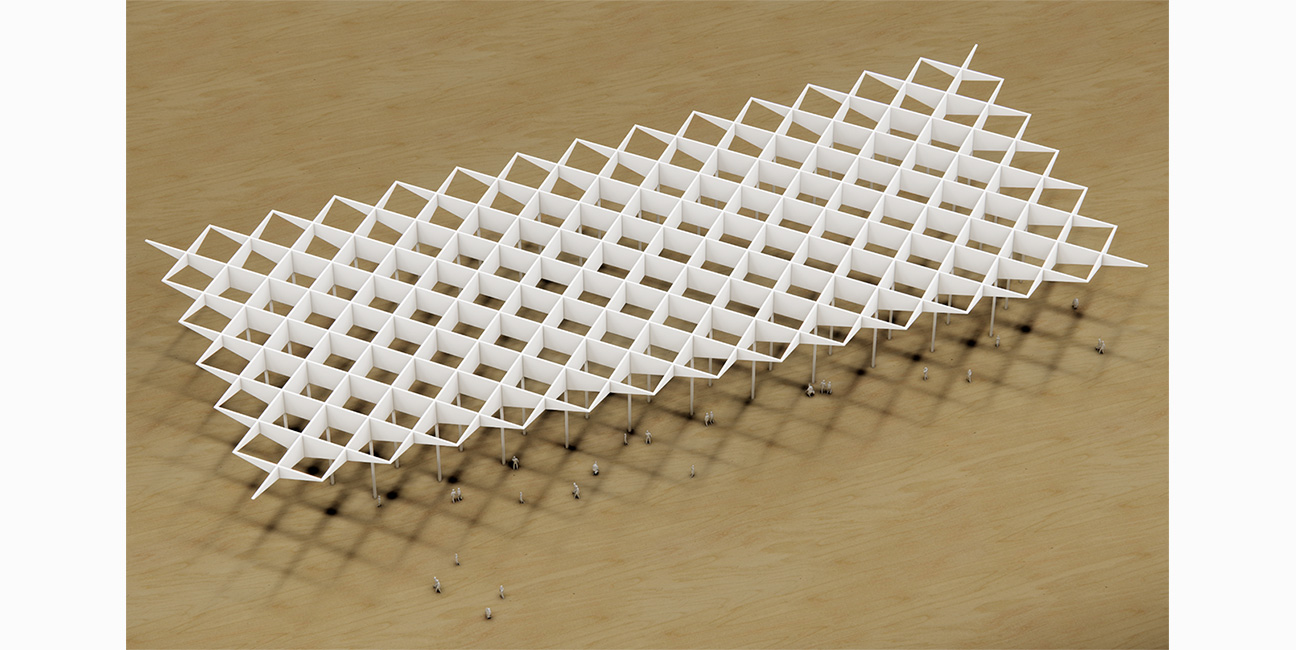
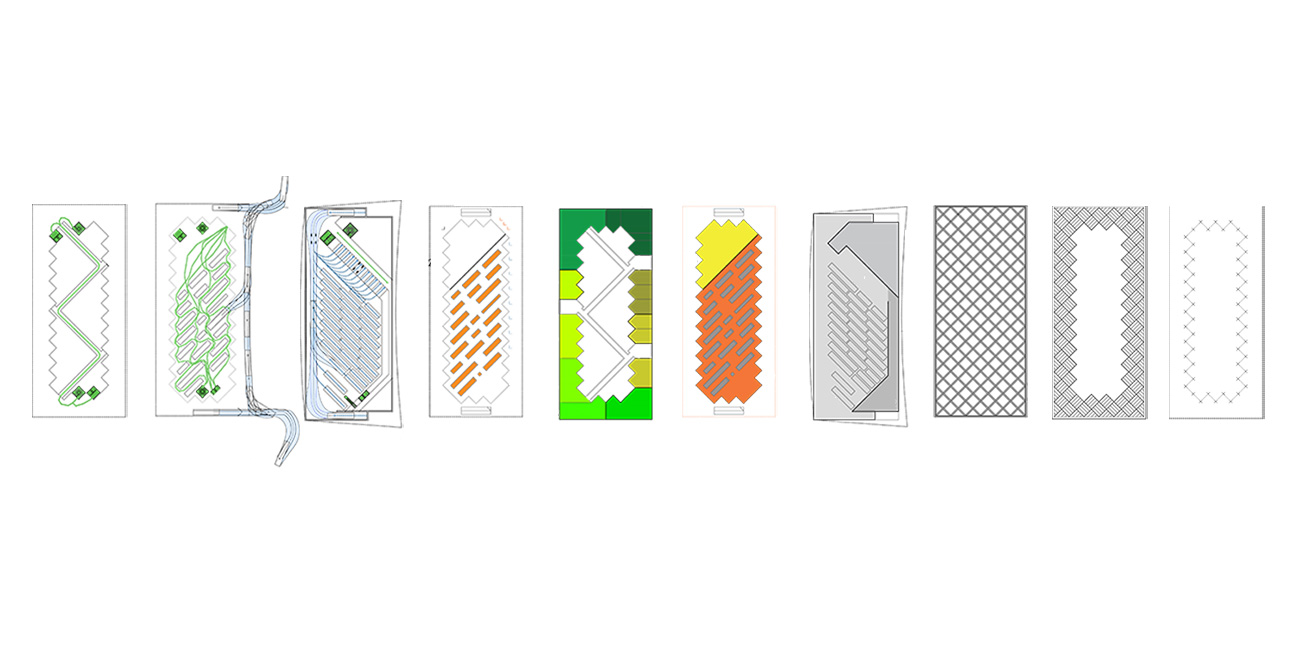
If we interpret this site as a transition between a natural and an urban environment, and consider the rectangular shape of the plot, a clear order emerges. However, the layout of the bus turns introduces an additional geometric pattern that must be integrated into a single spatial system. A two-way grid of edge beams organizes a spatial structure that creates an open, airy space. The main floor slab is suspended from this grid. Only a series of columns reach the ground, allowing for the permeability of views, visitors, and buses.
A UNIQUE STRUCTURE
The beam and floor structure is proposed to be made of laminated timber to lighten and expedite its industrialized construction, as well as to contribute to reducing its environmental impact. The wood is also intended to lend a certain warmth to the light that filters through the roof’s skylights, illuminating an interior where buses are the central focus. The main floor’s columns and tension members are planned to be made of metal to allow for their construction with slender dimensions that ensure the continuity of the floor plan and its connection to the exterior.
A CIRCULAR INTERVENTION
The proposed structure has a low environmental impact for several reasons. Firstly, the use of wood for the vast majority of structural elements and partitions results in a positive carbon footprint. The remaining metal elements have a greater impact but are reusable and recyclable. The above-ground structure is easily dismantled and reused. However, the materiality is not the only sustainable feature; the generic geometry, which adapts versatility to other uses, also contributes to its sustainability. The EMT Museum is housed in a large, open-plan structure whose spaciousness and transparency allow it to be adapted to other uses without significant modifications. This same spatial structure can accommodate, for example, a sports center with courts in the central space and gyms and other facilities on the upper floor. When assessing the sustainability of a building, one must consider not only the impact of its construction and maintenance, but also its capacity to adapt to new uses and thus avoid future interventions that increase its environmental impact. The large roof provides protection for the interior space, which can be covered with solar thermal and, primarily, photovoltaic panels to contribute to the building’s energy supply, enabling it to achieve net-zero energy consumption.